We continue with the thread of strength development work. Just as we were commenting, You may have reached this point after having only completed the adaptive phase if you are a cyclist already experienced in strength work, or after having undergone a general hypertrophy phase, If you are a beginner in this type of training, or have any special need for general muscle gain.
Now we are ready to start the first of the main or specific phases: phase of development of maximum strength and explosive strength.
The objective of this phase is improvement of maximum strength and the ability to produce force per unit of time.
We are going to obtain the improvement of maximum and explosive strength through theincrease in specific muscle hypertrophy of fast fibers, adding the component high speed execution with high loads where we will seek greater recruitment of these fibers to the detriment of the slow fibers that we work with with medium-high loads at medium-low speed..
And it is that the execution speed will be the fundamental load component to generate specific adaptations for our modality, so we should try to control this parameter as much as possible. Although there are currently various mobile applications that you can use for this purpose, The fundamental tool to control the execution speed is the well-known linear encoders..
Although its use is ideal, their price is not so much, and we know that it is not easy to access this tool for home use. That is why in this post we are going to give guidelines so that you can control your training whether you have or do not have an encoder..
Training control without encoder.
The methodology will be similar to that described in the previous post, except because we are going to fInalize the number of repetitions as soon as we perceive a decrease in the speed of execution. The first thing we must control is our 1 RM (weight we can lift in 1 single repetition max) approximate and know that on this value we are going to be moving above the 65% from the RM and up to 85%. As you can see in the table below, normally these loads would represent a range of repetitions from 15 maximum repetitions with the 65% to 5 o 6 repetitions with 85%. Only for this phase of specific development of the fast fibers we are not going to try to reach this number of maximum repetitions but the limit will be at the moment when we perceive a decrease in the speed of execution.. Therefore it is likely that with the load of the 65% of the RM, you're just doing 8-10 repetitions at maximum or almost maximum speed. This is what is known as character of effort, and an example of this series make a series 10 repetitions with the weight of 20 possible.
In this phase the training will targeting cycling-specific muscle groups, mainly quadriceps and glutes, although in a synergistic way (they participate in the movement) the calf muscles are also worked, abdomen, lumbar and other hip fixators.
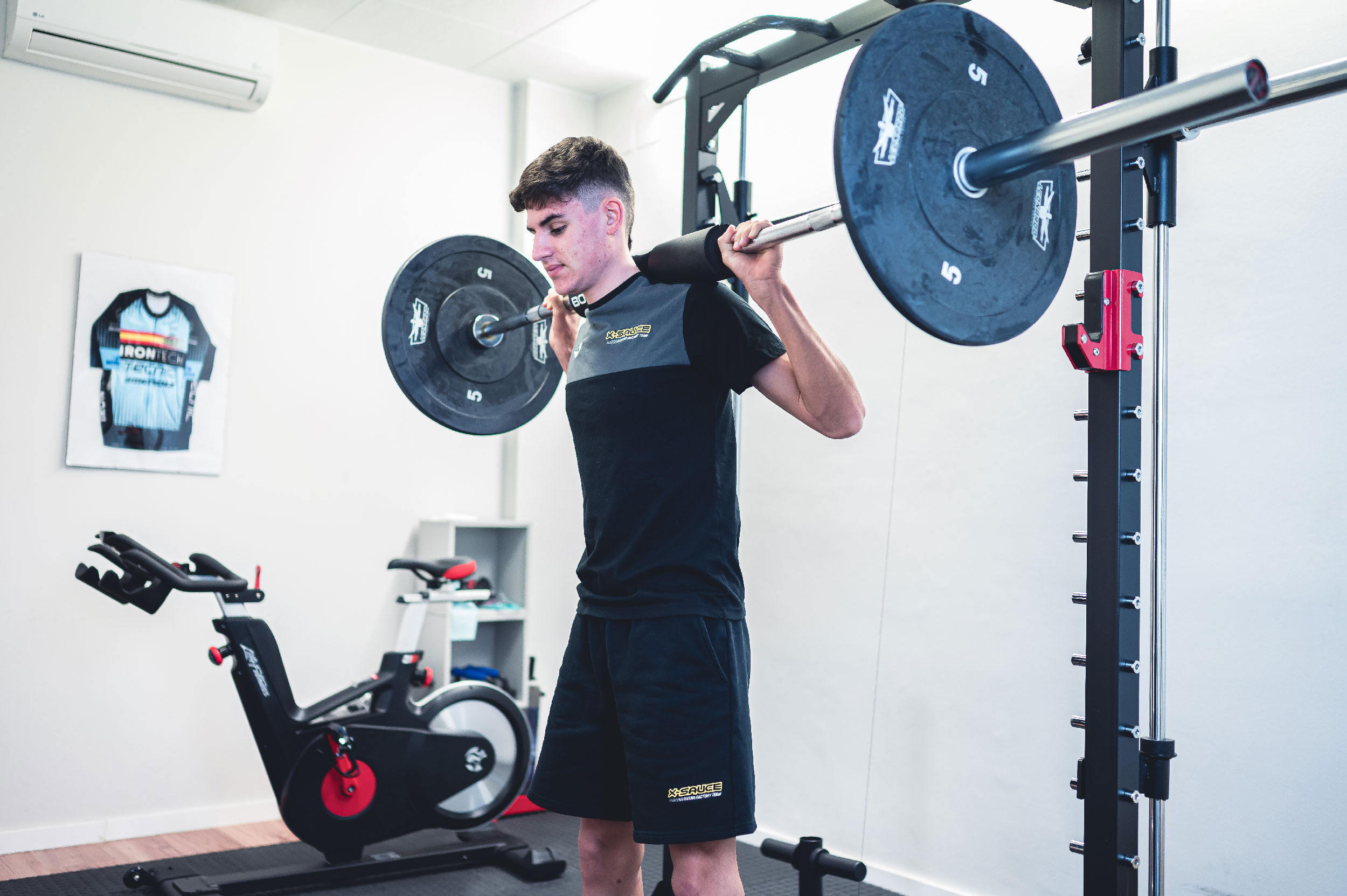
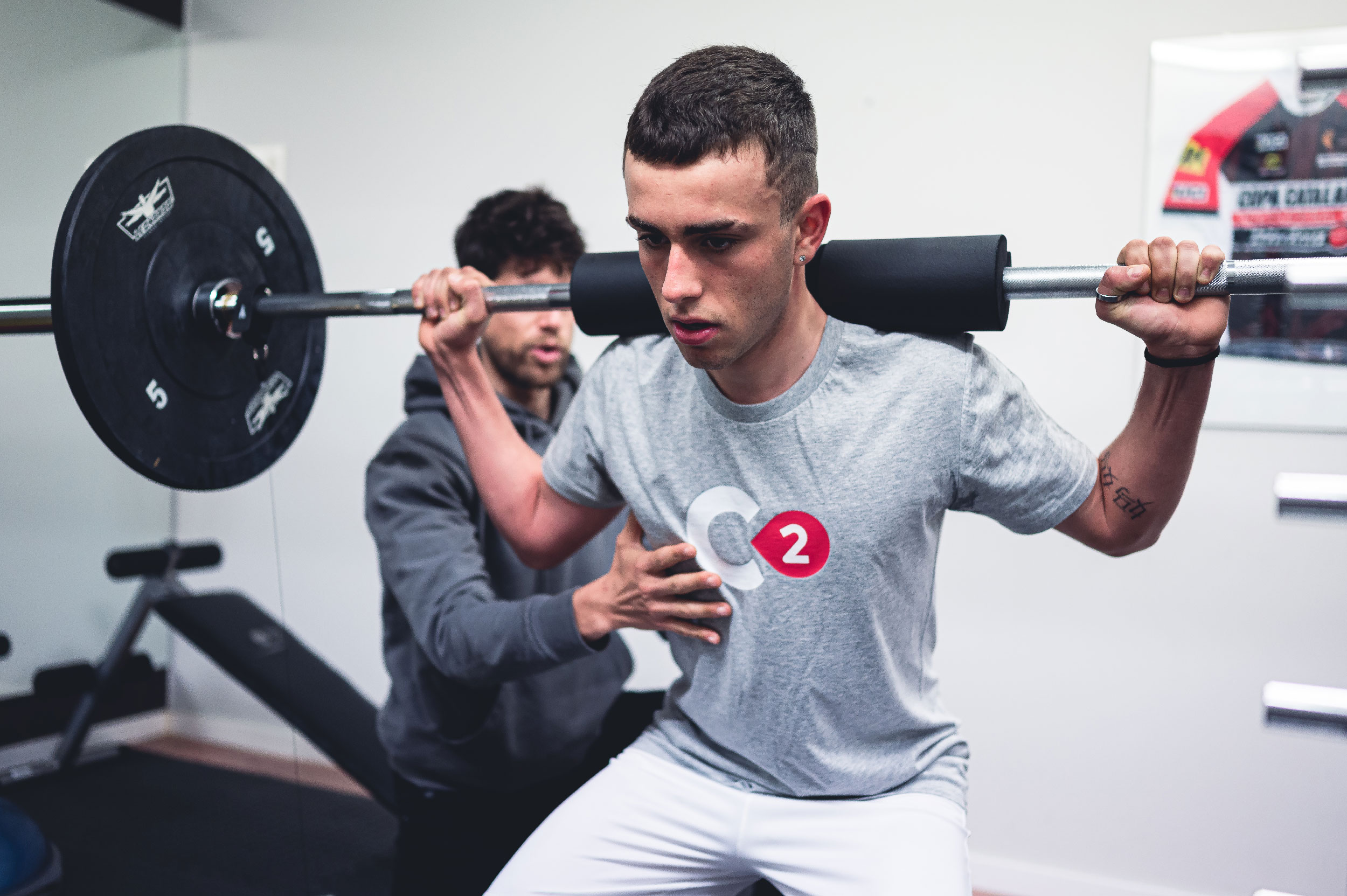
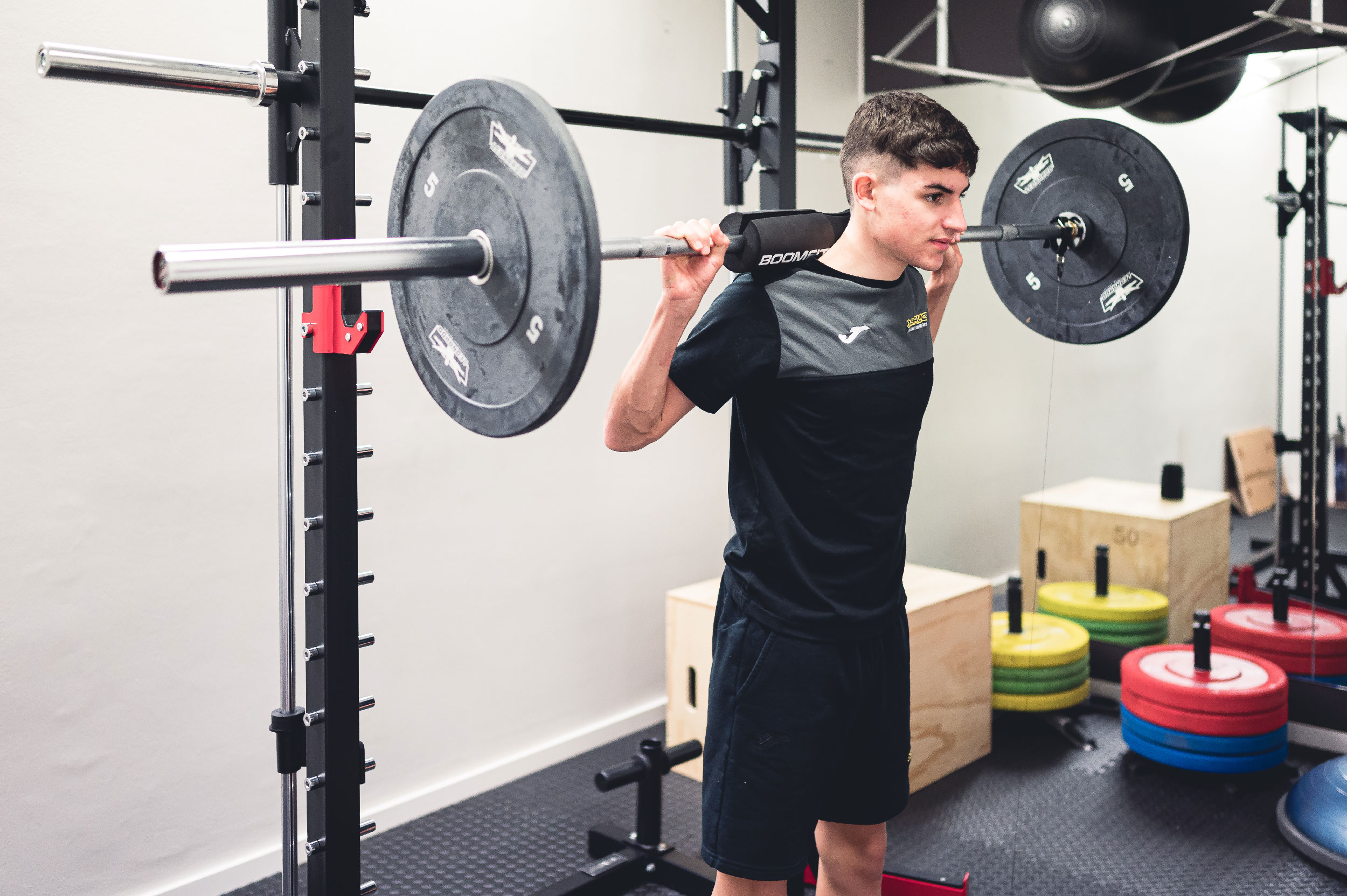
Therefore choose from 2 – 3 main exercises like squat, press, bench press with weight or lunges. Start your first sessions with 2 o 3 series per exercise with medium loads (65-70% RM) and aim to progress during 3 to 9 weeks until reaching the 80-85% RM.
Training control with encoder.
As in the previous case, we used MRI to control intensity, here using our encoder the first thing we should know is the peak power and the speed we generate with each load. We will discover this through a load test – speed or power – speed. For this, perform 1 o 2 repetitions with different loads, starting from a low load until you get close to your maximum load.
From here on, the methodology used is the same as what was explained above.. Using loads of 65% al 85% of maximum load, We should try to perform repetitions that remain above the 80-85% of the maximum power for the selected load, which in turn normally corresponds to speed losses not exceeding the 30%.
An example would be to perform repetitions with the 70% from the maximum load to a decrease in speed of one 10-15%.
As the weeks go by you should improve compared to the initial values, Just as there may be days when you are not able to perform the same speed for similar loads. That is why we recommend repeating the speed load test once every 3-4 weeks, in addition to adapting the workload in each session depending on the power and speed levels that you are offering for each session and exercise.
This phase should last as we said before. 3 to 9 weeks trying to progress from 65% that's him 85-90% of maximum load, with its corresponding decrease in repetitions that are useful (understanding useful as those in which speed and power remain above the 80% of the maximum) as we increase the load.