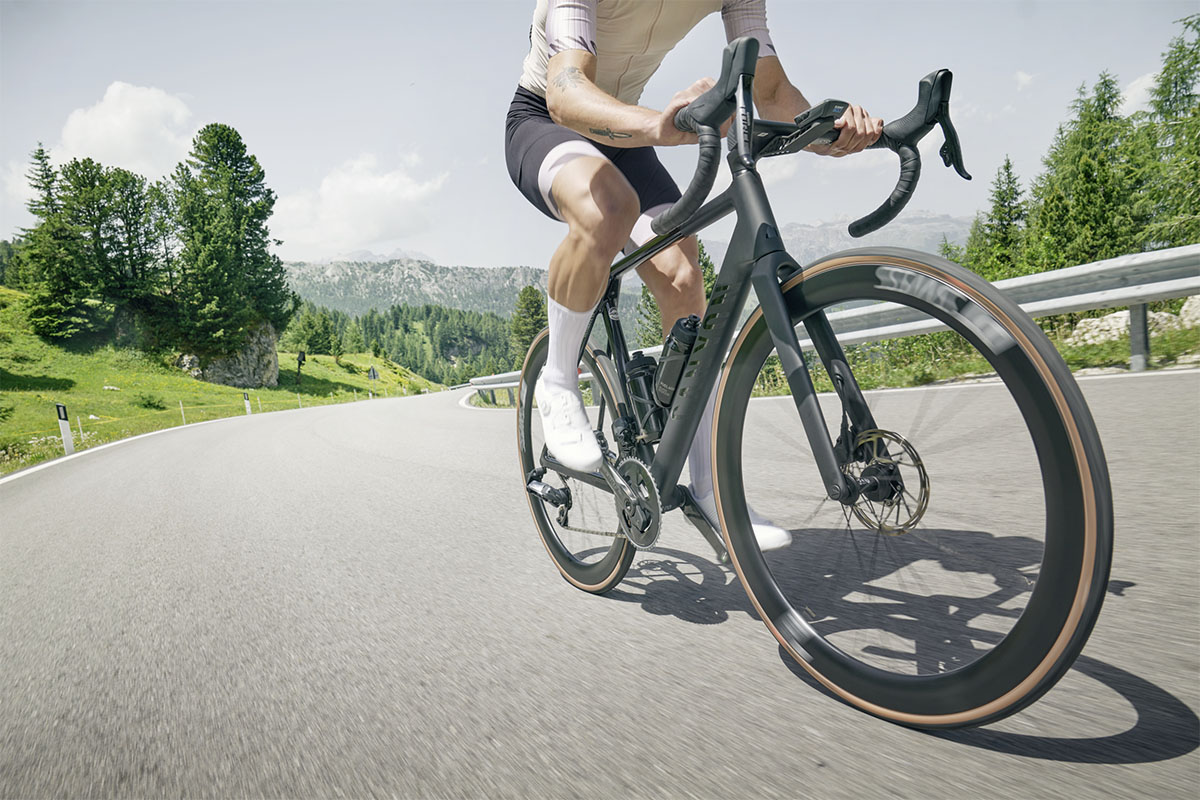
The pedaling cadence is the same as the revolutions per minute in any motorized vehicle, In this case, revolutions per minute will be the cadence that the cyclist gives to the pedals.. We must understand then, that an optimal cadence can make our engine more “drowned” or “lighter” depending on the revolutions of the legs of the athlete who is on the bike..
To summarize quickly, Pedaling cadence is the number of times a cyclist completes the entire pedal cycle.. It is a topic that is currently highly discussed among cyclists., since there are different trends if we look at a professional platoon, group of friends or even among the best bikers of the moment.
There is a tendency to establish a value between 80 and 90 revolutions per minute (rpm) as standard value in neutral conditions: flat road, no wind, on a road bike and working in the aerobic zone of our metabolism.
There are studies (Coyle et al. 1991) which confirm that at a low cadence (50 – 60 rpm) gives us greater energy efficiency in power production and is more economical since it reduces maximum oxygen consumption and there is a decrease in heart rate. Other studies have also appeared more recently that say just the opposite., As pedaling power increases, this mechanical efficiency also increases (Garcia – López et al.. 2009).
This cadence may vary depending on: the age of the participant, the inclination of the terrain where the athlete passes, the modality, your level of flexibility of the lower body and the play of the joints and tendons of your legs or adverse atmospheric situations.
Regarding its influence on sports performance, it can cause more or less wear on the athlete and a greater or lesser transmission of force to the pedal and consequently, to the pedaling cycle mentioned above the fact of having a slower or lighter cadence.
It has been shown in different studies that a lower pedaling cadence results in a greater recruitment of fast type II fibers., giving greater lactate production at the muscle level, that as a consequence, there is an earlier appearance of muscle fatigue as this lactate accumulates more quickly in the blood. Besides, It is also true that a lower cadence results in lower cardiac output..
As the opposite, we have high or medium cadences (greater than 75 rpm up to 110 rpm) where it can favor venous return and muscle recovery since our legs do not support so much workload. It is also true that the higher the cadence, the less force is applied to the pedal..
As a result of this information, The power – speed relationship will form an inverted parabola where the maximum power can be achieved at a certain cadence.. We will reach submaximal power at different cadences, not just one as is the case of maximum power.
This torque or other data that can come out of each of our pedal strokes in a dual potentiometer can be obtained a series of metrics and information through the Training peaks itself or more advanced, WKO5.
Torque This will be the angular force that rotates the pedal and is measured in Newton meters (Nm) as a unit of measurement..
GPR (Gross power realised) It is the power produced that contributes to the movement of the bicycle (positive tangential force).
GPA (Gross power absorved) It is the power produced that does not contribute to the movement of the bicycle (negative tangential force).
Torque effectiveness: That % of the pedal stroke we push with each pedal stroke.
Fluidity or smoothness: It is the difference between the maximum and minimum point of force during pedaling..
Pedaling efficiency: The thrust effectiveness of the forces transmitted in the pedal.
All this data can be obtained from each training session and each pedal stroke that a cyclist makes in their training., with which, You can improve pedaling and data obtained in your outings or sports tests..